


LONDON — A major unveiling took place in London on Wednesday as the Victoria and Albert Museum opened its doors to a new $53 million wing of remarkable treasures. Ten new galleries at the V&A feature more than 1,800 objects spanning the Middle Ages to the Renaissance eras. One of the collection highlights is five of Leonardo da Vinci's small notebooks (1487-1505) on permanent display for the first time.
The V&A museum hopes its seven-year overhaul project will change the public perception of the Medieval period, a timeframe so often associated with plague, war and turmoil. "We want our visitors to take away with them a feeling of the luxury, the color and the sophistication of this period," said the museum's director, Mark Jones. "This was not a dark period in history."
From textiles, paintings and sculpture, to glass, metalwork, prints and manuscripts, to furniture, ceramics and jewelery, the V&A's new wing houses all sorts of objects of European art and design. The ten new gallery rooms cover the years 300 to 1600 and are organized by theme as follows:
- Faiths and Empires, 300-1250: Explores how Christian art forms developed within the later Roman Empire. Early medieval rulers, such as Charlemagne, looked back to the forms and values of Roman art. It also shows how from about the year 1000, the increasingly powerful Christian church found a visual expression in the magnificent stone churches and abbeys that dominated the landscape.
- Devotion and Display, 300-1500: Looking at how religion affected Europeans' daily lives, this gallery shows religious artworks commissioned by town councils, corporations and wealthy individuals as 'good works'. The displays explore the world of public worship as well as the more private world of personal religious devotion. Onyx window screens act as filters for light and as a background on which to display the objects dramatically.
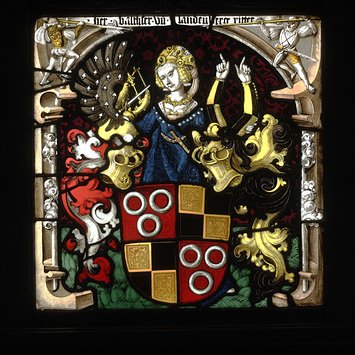
- The Rise of the Gothic, 1200-1350: The development of the Gothic style is set in a wider social and cultural context in this gallery. Although it developed in France, the Gothic style was rapidly adopted in most of Europe. The concepts of chivalry and heraldry developed during this period. Displays of stained glass, ivory and luxurious church embroideries are presented in this intimate space.
- Noble Living, 1350-1500: Devoted to luxury goods found in the households of rich nobles and wealty merchants, occasionally contrasting them with more humble goods. The gallery focuses on moments of ostentatious display, such as hunting, dining and courtship. A number of objects reflect life at the court of Burgundy, one of the most luxurious of the 15th century.
- The Renaissance City, 1350-1600: Large-scale works, once part of impressive Renaissance buildings, are displayed in the context of the cityscape. At its heart is the courtyard and the garden, with dramatic sculptures, trees and water. The church interior display, evoked by major altarpieces and stained glass, includes the Renaissance chapel from Santa Chiara, Florence. The choir screen from the Cathedral of St John at Hertogenbosch, one of the largest objects on show, dominates the gallery.
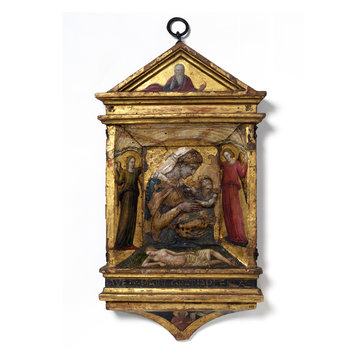
- Donatello and the Making of Art, 1400-1500: The V&A's exceptional collection of sculptures by Donatello, the most important and influential sculptor of 15th-century Italy, are presented in this gallery. It also shows works that explore the wider context of Italian artistic production.
- Renaissance Art and Ideas, 1400-1550: Renaissance ideas and beliefs, particularly the interest in antiquity and classical precedents, are explored here, together with the creative process of the artist. New technologies, notably printing, disseminated ideas and designs, and objects expressed identity and family ambition. Central to the gallery is a display evocative of a scholar's study decorated with Luca della Robbia's ceiling roundels from Piero de'Medici's study.
- A World of Goods, 1450-1600: Examines how design ideas were exchanged within and outside Europe. Objects, sometimes specifically designed for the Western market, were imported into Europe, and Islamic and Chinese techniques were imitated by European craftsmen. Exploration, conflict and diplomacy all played a part, with traditional trade relationships with the Islamic world complemented by new markets in the Far East and the New World.
- Splendour and Society, 1500-1600: The rich decoration and furnishings of the domestic interior form the setting of this gallery. Displays explore various aspects of life and social ritual. On show are luxury goods such as jewelery and furniture, armor and an impressive display on dining. Niches contain a selection of treasures and curiosities that a Renaissance collector might have assembled, and objects relating to health and beauty.
- Living with the Past: This new day-lit gallery examines the medieval and Renaissance past by bringing together large-scale objects, including the façade of Sir Paul Pindar's house from the city of London, with 19th-century plaster casts and photographs. The display highlights how fragments of the past remain in the towns, cities and rural landscapes of Europe.
 |  |  |
============
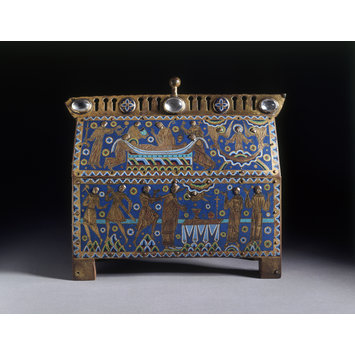
[Images: Top - Leonardo Da Vinci, "Volume II, Forster Codex" (ca. 1495) | Bottom, left to right - "The Becket Casket" (ca. 1180-1190). Donatello, "Virgin and Child" (ca. 1435-1440). "Arms of Balthasar II von Hohenlandenberg" (ca. 1500). Courtesy V&A Museum.]


